
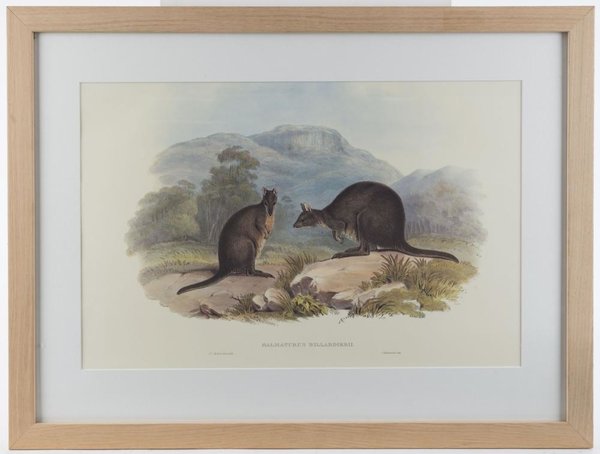
JOHN GOULD (1804-1881) Halmaturus Billardierii Facsimile Lithograph
$225.00
Description
Tasmanian Wallaby / Tasmanian Pademelon
Facsimile of the 19th-Century Gould & Richter Lithograph
Framed — 52 × 34 cm
The Tasmanian Wallaby
John Gould & H. C. Richter
Artwork Details
Title: Halmaturus Billardierii
Subject: Tasmanian Wallaby / Tasmanian Pademelon
Modern scientific name: Thylogale billardierii
Original publication: The Mammals of Australia, Vol. II
Original publication date: 1863
This example: Facsimile lithographic print
Dimensions: 52 × 34 cm
Presentation: Matted and framed in contemporary natural timber frame
An attractive framed facsimile of Halmaturus Billardierii, one of the celebrated Australian mammal illustrations published by the great British naturalist and ornithological publisher John Gould (1804–1881).
The composition depicts a pair of Tasmanian wallabies within their natural landscape, surrounded by native vegetation with the mountainous Tasmanian landscape rising softly in the distance.
Its restrained colouring and meticulous zoological detail are characteristic of the magnificent natural-history illustrations produced for Gould's monumental studies of Australian wildlife.
Gould identified the animal as Halmaturus Billardierii and called it the Tasmanian Wallaby.
The species is now classified as Thylogale billardierii and commonly known as the Tasmanian pademelon. Its natural distribution is Tasmania, and Gould himself recorded the animal's association with Van Diemen's Land and the larger islands of Bass Strait.
The original illustration belongs to Gould's great The Mammals of Australia.
The Biodiversity Heritage Library records Halmaturus Billardieri, Tasmanian Wallaby in Volume II, published in 1863, while the National Gallery of Victoria identifies Henry Constantine Richter (1821–1902) as draughtsman and lithographer for the work.
Gould's mammal publications are among the most important illustrated records of Australian zoology produced during the nineteenth century.
After: John Gould (1804–1881) / H. C. Richter (1821–1902)